Sandra's denunciation of Troy
Gang Up: A Bikerland NovelSandra's denunciation of Troy turns a battle assembly into a public reckoning. As the Family and the Cauldron gather outside Temple for an open fight, Sandra steps between Troy and his audience, names him as the author of the conflict's most consequential betrayals, and presents witnesses to Titus's murder. The accusation does more than interrupt a speech: it makes the Family's internal allegiance uncertain at the moment its soldiers are supposed to move against an enemy.
War and Political Setting
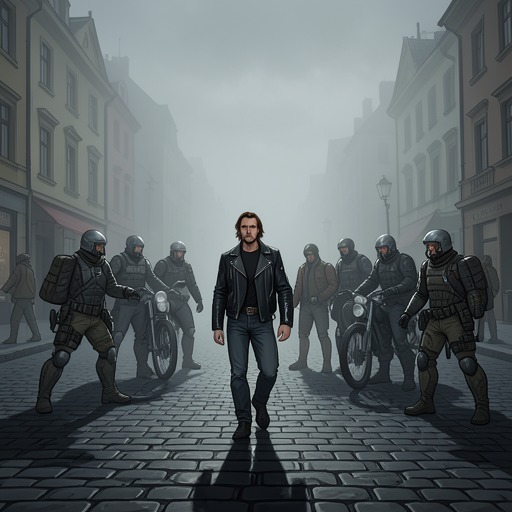
By the morning of the confrontation, the belligerents had agreed to abandon sneak attacks and gradual encroachment in favor of meeting openly outside town. Case's written plan, discussed with Troy through the night, was to wipe out Brall; the larger intention was to end the conflict. Troy welcomed the prospect of a melee. The gathering appeared to be a straightforward contest of force: rows of roaring motorcycles, fighters carrying hatchets, planks, spikes, knives, chains, shotguns, and spears, and a Family contingent estimated at roughly one and a half times the size of the Cauldron's.
That public military order rested on a coercive system at home. The Family claimed to serve all of Temple, funding itself through raids for land, loot, and women. Its own members received first choice, followed by favored Kin, while ordinary residents could live in Temple but had to pay taxes to receive the full protection of Family rule. Earlier that day, guards had turned away a crowd demanding entry to the Compound, warning them to return home or face gunfire. These circumstances do not establish that the crowd at the gates was the same group as Sandra's witnesses, but they show how protection and force shaped the town's political life beyond the battlefield.
The struggle for resources had already become literal. Brall's assault on the spring took place near dusk, when the defenders had the setting sun in their eyes and he had surprise. The short fight left two of Brall's men and five Family men dead; the survivors surrendered and were chained as potential hostages or bargaining pieces. Brall intended to show some clemency because he wanted to rule the people he had conquered, not deprive them of all their men. Against this background, the open battle was also a contest over who could claim Temple and its means of survival.
Sandra Interrupts the Assembly
Troy raised his arm to ready his men and began the kind of speech Case knew he enjoyed giving. He had barely begun when Sandra walked forward, her expression grave enough to quiet the roar of the motorcycles. Five Temple townspeople stood behind her. Her appearance was not an interruption improvised in the moment: the narration makes clear that Case and Brall had planned it. The arrangement placed a public accusation directly in front of the assembled forces, before Troy could turn their attention toward battle.
Sandra spoke plainly and pointed at Troy. She called him a snake and said he had always been one. The crowd murmured; the account does not present them as uniformly surprised or hostile to her charge. Even Troy's own men knew his deviousness, and his unease became visible as he looked toward the townspeople behind Sandra. Her accusation challenged the familiar usefulness of his cunning: a quality some of his followers had accepted as an advantage now made betrayal credible.
She then specified what she said Troy had done to escalate the war. He had acted alone in killing Carthage, the Cauldron's man, and, when Case did not respond immediately, had destroyed the grain tower and part of the Compound to provoke action against Brall. The crowd gave these charges weight. Carthage's killing was established as true; the sabotage allegation seemed plausible to people who already considered Troy devious. Sandra was not simply blaming him for an enemy's death. She was presenting him as someone who had manipulated his own side's response and endangered its property to force the conflict forward.
Witnesses and the Charge Against Troy
Sandra described Titus's murder as Troy's worst offense, naming the dead man as her own Titus and as the community's. She argued that the conflict could not continue with a traitor among them. The crowd's reaction was divided between murderous insults and demands for proof; some people already believed Troy had killed Titus, but belief alone did not settle the accusation.
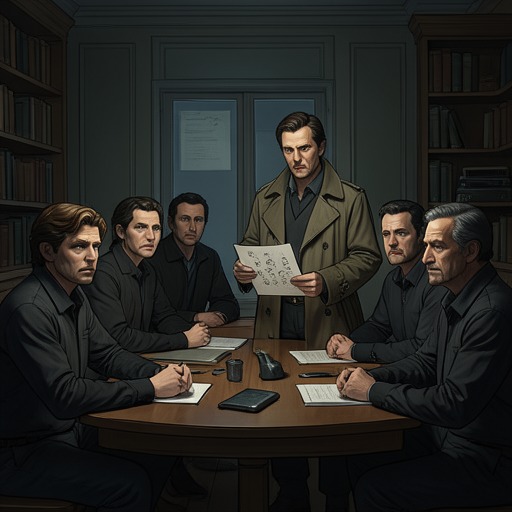
Sandra answered by indicating the five witnesses behind her. She described them as townspeople with no stake in who ruled Temple. She singled out Gadson, the town baker, who had received special protection and payments for his goods from Troy. His former connection to Troy made his appearance against him more pointed: Sandra's explanation was that he had turned because events had gone too far and he wanted justice. The witnesses, she said, had seen Troy run Titus down and shoot him in the head, in the same manner in which he had killed Carthage. The accusation therefore joined a claim of political manipulation to eyewitness testimony about Titus's death.
The Fracture and Its Immediate Consequence
As the testimony took hold, the crowd boiled over. Case's men and Troy's men began separating, but the rupture did not fall neatly between the two forces: some of Troy's own followers also drew away from him. The narration notes that many were willing to accept the truth of the charges and refuse to follow him. Sandra's intervention thus changed the battle assembly before the battle could begin, exposing a fault line within the Family rather than merely rallying one army against another.
Troy abandoned any attempt at concealment and lunged at Sandra with a knife. She sidestepped his clumsy attack and knocked him into the dust. When he charged again, Case struck him down, kicked the knife away, and beat him while the assembled people let the assault continue without interference. For Case, the blows were personal: Troy had killed his father, Titus. The scene ends with Troy bloodied on the ground, his accusation answered by physical force rather than a formal judgment in this moment. Sandra's speech has made the planned battle an internal confrontation over treachery, kinship, and whether the Family will continue to follow the man she has publicly accused.